Insights
Legacy to cloud-native: a practical migration playbook for US enterprises
30 April 2026 · 7 min read
 Niran FernandoPrincipal cloud architect30 April 2026 · Updated 15 September 2026 · 7 min read
Reviewed by Samuel Okonkwo, Manufacturing & integration lead.
Written from Velosius plant-to-cloud and strangler-API programmes. Samuel Okonkwo reviewed the manufacturing cutover notes against how we actually run hypercare.
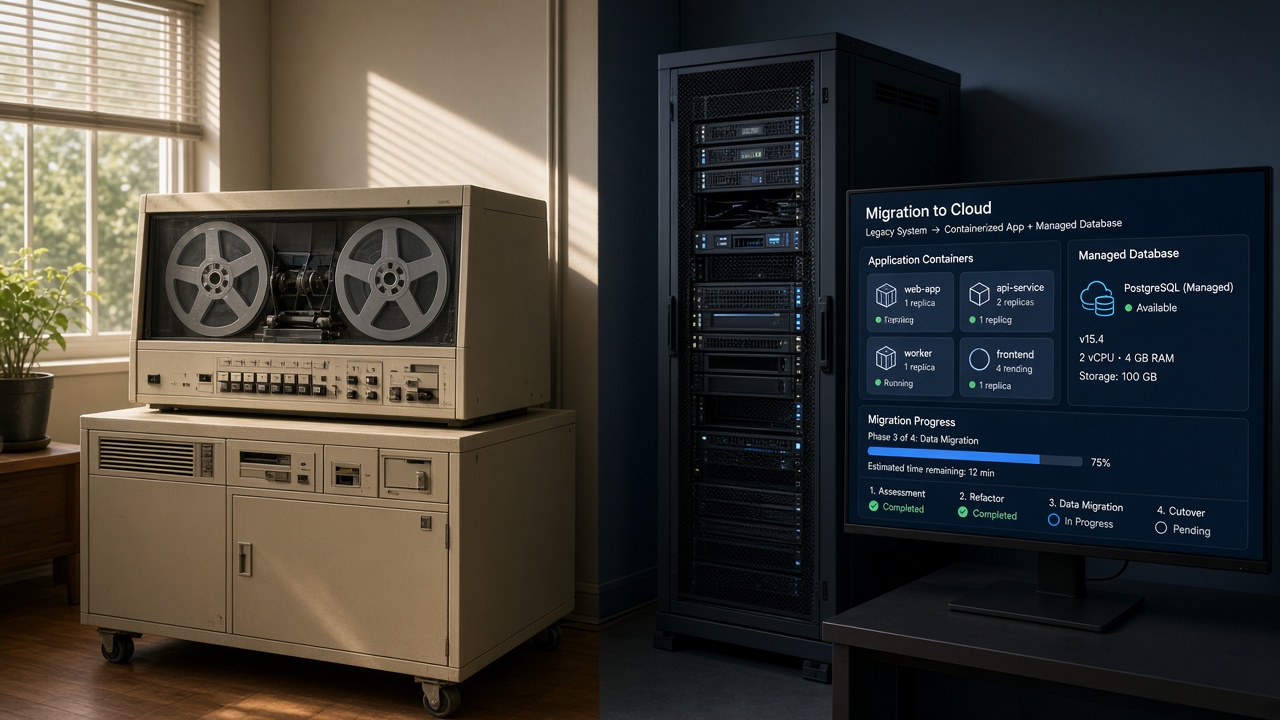
US mid-market enterprises often run critical revenue on systems built 10–20 years ago — monolithic .NET or Java apps, on-prem SQL Server or Oracle, batch jobs on scheduled servers. Lift-and-shift to EC2 saves datacentre rent but not operational pain. A cloud-native playbook focuses on incremental modernisation with measurable risk reduction at each step.
Step 1 — Inventory and classify
Before touching infrastructure, catalogue applications by business criticality, technical debt, and dependency map. Classify each system into one of four paths:
- Retire — unused or duplicate; decommission.
- Retain — keep on-prem or hosted as-is for now; set review date.
- Replatform — move to managed service (e.g. RDS, Azure SQL) with minimal code change.
- Refactor / rebuild — strangler pattern or full rewrite for cloud-native targets.
Executive sponsorship matters here: without agreement on what can retire, migrations stall on “we might need it someday.”
Step 2 — The strangler fig pattern
Big-bang cutovers fail. The strangler approach routes traffic incrementally from the legacy monolith to new services behind an API gateway or load balancer. Start with read-only APIs or low-risk features — reporting, notifications, admin tools — then tackle core transactions once observability proves stability.
Containerise new services (ECS, EKS, or Azure Container Apps) from day one. Use managed databases with automated backups and point-in-time recovery. Keep the legacy database as system of record initially; sync or dual-write only where you have tested rollback.
Step 3 — Data migration discipline
Data is where migrations slip. Plan explicit migration windows, validation queries (row counts, checksums, sample business invariants), and a rollback path. For US firms with state privacy laws, track personal data residency — which tables hold PII, and whether the target region meets contract and regulatory requirements.
Event-driven sync (change data capture) often beats overnight batch dumps for systems that must stay online during transition.
Step 4 — Cutover and hypercare
Define go/no-go criteria: error rates, latency p95, support ticket volume. Run parallel operation for at least one business cycle where feasible (e.g. two pay periods for payroll-adjacent systems). Staff hypercare — dedicated engineers on call for 2–4 weeks post-cutover with authority to roll back without committee approval.
What good looks like at 12 months
A successful US mid-market migration delivers: lower mean time to deploy (from weeks to hours), autoscaling for seasonal demand, infrastructure as code for every environment, and a documented roadmap for the next tranche of legacy systems — not a single heroic weekend and silence.
Corrections: email hello@velosius.com with this URL. See our editorial policy.