Insights
Custom web application development: costs, process, and how to choose a partner
16 September 2026 · 16 min read
 Elena VossProduct & commerce lead16 September 2026 · Updated 4 October 2026 · 16 min read
Reviewed by Niran Fernando, Principal cloud architect.
Direct answer
Custom web application development is software that runs your workflow in the browser, in your cloud account. Buy packaged software when it already covers the job. Build when the process is the business — and hire a team that will name the engineers, ship one live pathway in 90 days, and leave the code with you.
Written from Velosius commerce and internal-tool programmes — catalogues, operator dashboards, and the API layer between two systems that were never meant to talk. Niran Fernando reviewed the cloud and account-boundary notes. Work snapshots on this site are composite; we do not invent named clients.
Off-the-shelf software gets a team started. Custom web application development gets the workflow out of the spreadsheet. If operators are working around generic tools — plugins stitched together, a catalogue nobody owns, a claims file that still needs copy-paste — a purpose-built application can remove that friction. It can also waste a year if you hired for a slide instead of a first live pathway.
Velosius is a 10-person studio in Colombo that builds custom web applications for UK and US mid-market firms. The people who scope the work are the people who stay on it. This guide is how we talk about custom projects: what they are, when they make sense, how the process runs, what they cost, and how to choose a partner. It is not a pitch for every brief. The first honest answer is often not to build.
What is custom web application development?
Custom web application development is designing, building, and running software that lives in the browser and is made for your processes, users, and constraints. You control the logic, the data model, and the roadmap. The software fits the business. The business does not bend to fit a vendor’s plan.
A custom web application usually has accounts, permissions, a database, business rules, and integrations. Typical shapes we see on UK and US programmes:
- Customer and partner portals: orders, invoices, documents, and support behind a login.
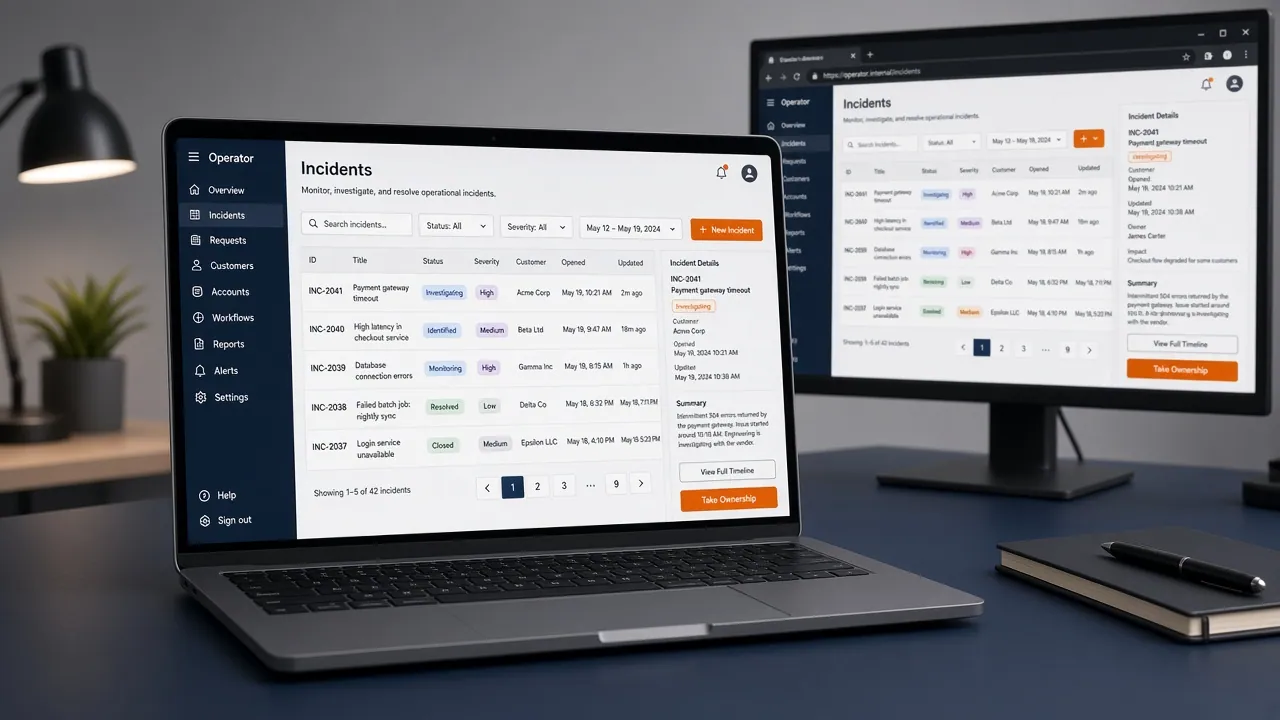
- Internal dashboards and workflow tools: approvals, exceptions, and the job somebody does every Monday.
- Commerce paths: one catalogue, every channel — see ecommerce ERP integration.
- Operator tools on top of insurance or healthcare stacks: extraction, triage, a human in the loop. Snapshots on Work are composite.
- The API layer between two systems that were never meant to talk.
A website tells people about the business. A web application does work for the business. If the page cannot name the person who will open it on Monday, it is still a brochure.
Custom web application vs website vs off-the-shelf software
| Website | Off-the-shelf SaaS | Custom web application | |
|---|---|---|---|
| Purpose | Inform and attract | A general workflow | Your exact workflow |
| Flexibility | Low | Medium | High — you own the roadmap |
| Upfront cost | Low | Low | Higher |
| Long-term cost | Low | Grows per seat | Predictable if you maintain it |
| Competitive edge | Minimal | None — competitors can buy it | The process is yours |
| Ownership | You own the site | Vendor owns the product | You own the code and data |
If a packaged product already covers 80 percent of the job, buy it. Custom work earns its keep when the process is the business — pricing rules, inventory across channels, a regulated document flow — and off-the-shelf tools force you to fake that process in a spreadsheet.
Benefits that actually show up on Monday
- Built around one owner and one job. Nothing is bloated because a sales deck asked for it.
- Hours back each week when the copy-paste loop dies, and fewer errors in the close.
- Users, features, and integrations without hitting a vendor seat cap.
- You choose hosting region, identity provider, and who can see a record.
- Connections that generic tools refuse: ERP, storefront, a legacy batch, a payment provider.
- Software competitors cannot buy, if the workflow is genuinely yours.
When you actually need custom development
Custom is not always the answer. It makes sense when:
- The process is the advantage, and forcing it into generic software dilutes it.
- Per-seat licences scale badly — at 50 to 100+ operators, subscriptions often cost more than owning the path.
- You need integrations nobody sells: legacy cores, plant batches, a catalogue in one system and a storefront in another.
- Security and residency matter: customer, patient, or payment data that has to live in a named account and region.
- You are building a product you will sell. A SaaS product is custom by definition.
Rule of thumb: if a standard tool does 90 percent of what you need, buy it. Custom is for the 10 percent that tool cannot solve — and for the owner who will still be there after go-live.
Not sure whether to build?
Send the workflow, the systems it must touch, and the constraint you cannot break. A named engineer will say build, buy, or stop. Fifteen minutes is enough.
The custom web application development process
A well-run programme is boring on paper. Knowing the stages is how you judge whether a partner has a process or a proposal.
- Discovery — name the users, the Monday-morning job, must-haves, and the number that will show it worked. This is the cheapest stage at which to fix a mistake, and the one most often skipped.
- UX — wireframes and a clickable path so operators can object before code. Design that ignores the person who will click it does not get adopted.
- Architecture — frontend, backend, database, and hosting from scale, security, and who will maintain it, not from whatever is trendy. That choice shapes cost for years.
- Build in slices — working software every one to two weeks. You see the path. You can redirect. You do not wait until month nine to discover the wrong workflow.
- Test — automated and manual checks, performance, accessibility, and a security pass before operators live with it.
- Launch — staged rollout, data move, monitoring. Many teams release to a pilot group first.
- Handover and iteration — hosting, patches, the next slice. A one-off dump of code with no runbook is not a finish.
At Velosius the first live pathway is 90 days, in your cloud account: weeks 1–2 name the workflow; weeks 3–6 ship the thinnest slice; weeks 7–10 put it in front of operators; weeks 11–12 leave runbooks and access. The next slice is a decision, not a retainer that assumes we stay forever.
How much does custom web application development cost?
There is no honest menu price without discovery. The ranges below are typical mid-market planning bands we see on UK and US briefs — not a Velosius rate card, and not a quote. Currency is shown in US dollars because that is how many US operators budget; UK programmes convert at the rate you close, not at a marketing FX.
| Project type | Typical planning band | Typical calendar |
|---|---|---|
| Focused internal tool or first live pathway | $15,000 to $50,000 | 6 to 12 weeks — our 90-day first pathway sits here |
| Mid-complexity platform (portal, workflow, a few integrations) | $50,000 to $150,000 | 3 to 6 months, phased |
| Regulated or multi-tenant systems | $150,000+ | 6 to 12+ months, never as one cutover |
What moves the number: number and difficulty of features; third-party APIs; roles and permissions; security and compliance (GDPR, PCI where payments are in scope, sector rules); depth of design; seniority of the people actually writing code. Location of the studio matters less than whether you speak to those people. Hiring a software development team on UK hours is a different buying question from buying a London slide deck.
Budget 15 to 20 percent of the initial build per year for hosting, monitoring, patches, and small improvements. Software that is not maintained becomes a liability. Start with the core 20 percent of features that deliver 80 percent of the value. Real operators then tell you what to build next.
Get a realistic range
Share the job, the systems, and a target date. After a short call we come back with a scope and a budget range you can take to finance — or we tell you to buy the packaged product.
Custom web portal development
A web portal is a custom web application that gives a named group — customers, staff, suppliers, partners — secure access to information and services. Typical pieces: single sign-on, role-based access, documents, tickets, invoices, a dashboard. The process and cost drivers match any custom application. Authentication, permissions, and integrations get extra attention. If the portal is really a second catalogue sitting beside an ERP, the commercial job is often ecommerce ERP integration, not a new storefront.
Custom web application vs WordPress
For content-led sites — blogs, brochure pages, a simple shop — WordPress is excellent and far cheaper. Custom development is the better long-term fit when you need accounts, complex workflows, business logic, high security, or heavy integrations. Many businesses run both: WordPress for marketing, a custom application for the product behind the login. Do not rebuild a working marketing site because a proposal asked for a new stack.
How to choose a custom web development partner
The partner matters more than the framework. Look for:
- Relevant, verifiable work — and honesty about what is a composite snapshot versus a named client. We publish composites on Work. We do not invent logos. See the editorial policy.
- Senior involvement — who writes the code after the architecture slide. Named engineers, not an account layer.
- Transparent process and pricing — what you pay for, and when you will see a path operators can click.
- Code and IP — you own the source, with documentation, in your cloud account.
- Security-first practice — authentication, data protection, testing, dependency updates. Design against the OWASP Top 10.
- Post-launch support — who you email at 7am UK time, and what handover includes.
- Overlap hours — UK afternoon or US hours, written updates, a named point of contact. Daniel Hartley (UK) or Maya Chen (US).
Red flags
- A fixed price with no discovery.
- Vague timelines and no first live pathway.
- No working demo until the end.
- Reluctance to hand over code or to run in your account.
- Pressure to sign before the workflow is named.
- A senior name on the pitch and a junior bench on the build.
Questions to ask before you hire
- Who exactly will work on this, and what is their seniority?
- Can I speak to the person who will write the API, not only the person who sold the workshop?
- How do you handle scope changes?
- What does handover include, and who owns the code?
- Where does the application run, and whose identity provider is it?
- What are your security and testing practices?
- What does support cost after the first pathway is live?
Custom web application development with Velosius
Velosius Ltd is a boutique studio: ten named specialists, English-first, aligned to UK and US hours. We keep the team small on purpose.
- Senior-engineer-direct delivery. You are not handed to a junior team after the call.
- The app lives in your AWS, Azure, or GCP account, behind your identity provider.
- A 90-day first live pathway, with monitoring and rollback — then a decision to extend or stop.
- UK and US mid-market focus. GDPR-aware design. Overlap with your afternoon, not a night shift that replies the next day.
- You own what we build. Source, documentation, and the audit trail stay with you.
What we actually build: operator dashboards; customer and partner portals; commerce integrations; production AI with a human in the loop when the workflow already has volume; the path between a plant batch and the close, which is a manufacturing programme first. We do not sell a staffing mill, and we do not invent client names to dress a case-study page.
How to start
- Send an enquiry on the contact page — the problem, who will use it, must-haves, systems it must touch, any residency or compliance constraint, a target date, and a budget band if you have one.
- We reply, usually within one business day, with questions. UK hours: Daniel Hartley. US hours: Maya Chen.
- A 15-minute call with a named engineer.
- A written scope, recommended approach, timeline, and budget range — or a recommendation not to build.
The contact form asks for name, email, company, topic, and a message. Put the workflow in the message. You do not need a 40-page brief. You do need the constraint you cannot break.
Technology without the jargon
You do not need to pick the stack. Your partner should explain the choice. Common, well-supported options: React or Next.js on the frontend; Node.js, Python, or .NET on the backend; PostgreSQL for structured data; AWS, Azure, or GCP for hosting. Prefer mainstream tools so you can always find people to maintain the system. Trends are not a strategy. Cloud migration is a separate programme when the painful workload is still on rented iron.
Common mistakes
- Overbuilding version one. Launching every feature at once delays the first operator.
- Weak requirements. Skipping discovery is more expensive than a week of workshops.
- Ignoring end users. Software built without the person who will click it rarely gets adopted.
- Treating security as an afterthought. Retrofitting it is costly. Start from who can see a record.
- No maintenance plan. Applications need updates after go-live.
- Hiring “near me” for an office park instead of overlap hours with the people writing production code.
Final thoughts
Custom web application development pays off when the software is tied to how the business makes money or saves time. Define the problem. Start with one pathway. Choose a partner who will name the engineers, put the work in your account, and tell you when to buy instead of build.
If you are weighing a custom web application this quarter, the fastest clarity is a conversation with the people who would build it — not another RFP that nobody who writes code will read.
Ready to scope the pathway?
Tell Velosius about the workflow. A named engineer reviews the enquiry. No obligation, no slide deck.
FAQ
Before you brief a partner
How long does custom web application development take?
A first live pathway at Velosius is 90 days: one workflow, in your cloud account, with monitoring and rollback. A broader programme — extra roles, extra integrations — is phased after that, not a 12-month black box.
Is custom development better than WordPress?
For a content site, WordPress is usually enough. For user accounts, workflows, business rules, or heavy integrations, a custom web application is the better long-term fit. Many firms run both: WordPress for marketing, the application behind the login.
Who owns the code?
You should. The application runs in your cloud account. Source, documentation, and the audit trail stay with you. Confirm that in the contract before work starts.
Can I start small and scale later?
Yes. The first 90 days ship the core 20 percent that does 80 percent of the job. Architecture should allow the next slice without a rewrite.
What is the difference between a web portal and a web application?
A portal is a kind of web application: named groups get secure access to orders, documents, or support. Cost drivers are the same. Authentication, permissions, and integrations get extra attention.
How much does it cost to maintain a custom web application?
Plan on roughly 15 to 20 percent of the initial build per year for hosting, monitoring, security patches, and small improvements. Software that is not maintained becomes a liability.
Does Velosius work with clients in the UK and the USA?
Yes. Velosius Ltd serves UK and US mid-market firms. The studio is in Colombo. UK hours: Daniel Hartley. US hours: Maya Chen. We design for GDPR and for data that has to stay in a named region.
How do I get a quote for a custom web application from Velosius?
Send the workflow, the systems it must touch, and the constraint you cannot break through the contact page. A 15-minute call is enough to say build, buy, or stop. After that you get a written scope, timeline, and budget range.
Who will work on my project at Velosius?
The named engineers on the programme. Elena Voss leads product and commerce. Niran Fernando reviews cloud and account boundaries. We do not hand you to a junior bench after the sales call.
Is custom web development secure?
It can be, because you control authentication, hosting region, and who can see a record. Security is a practice, not a slogan. Ask about testing, code review, and dependency updates. See the OWASP Top 10 for the baseline we design against.
Corrections: email hello@velosius.com with this URL. See our editorial policy.
Commercial page
Custom web application development
Custom web application development by Velosius: named engineers, secure builds in your cloud, 90-day first pathway. Book a 15-minute call for a UK or US project.