Insights
Why UK mid-market businesses are accelerating multi-cloud adoption
28 May 2026 · 6 min read
 Niran FernandoPrincipal cloud architect28 May 2026 · Updated 15 September 2026 · 6 min read
Reviewed by Ishara Bandara, FinOps & platform engineer.
Written from Velosius cloud programmes for UK mid-market estates — connectivity first, data gravity second, cost treated as an operating problem.
Multi-cloud used to be a big-bank talking point. Today, UK mid-market companies — manufacturers, insurers, professional services firms, and growth-stage SaaS businesses — are actively running workloads across AWS and Microsoft Azure, and sometimes GCP for analytics. The drivers are practical, not theoretical.
Why now?
Three forces are converging. First, acquisitions and mergers leave IT estates split across platforms. Second, best-of-breed SaaS (CRM, ERP, data warehouses) each lands on the cloud their vendor prefers. Third, resilience and negotiation — no CFO wants a single hyperscaler holding 100% of compute without a credible alternative.
Brexit and UK data-sovereignty conversations also push firms to understand exactly where data lives and which provider holds the contract. Multi-cloud is less about running identical apps everywhere and more about right cloud for the right workload.
Common patterns we see in the UK
- Azure for identity and productivity — Microsoft 365, Entra ID, and line-of-business apps integrated with Active Directory patterns teams already know.
- AWS for product and data — customer-facing applications, serverless APIs, and data lakes where the ecosystem and marketplace are strongest.
- GCP for analytics and ML — BigQuery and Vertex used selectively when teams already standardise on Google tooling.
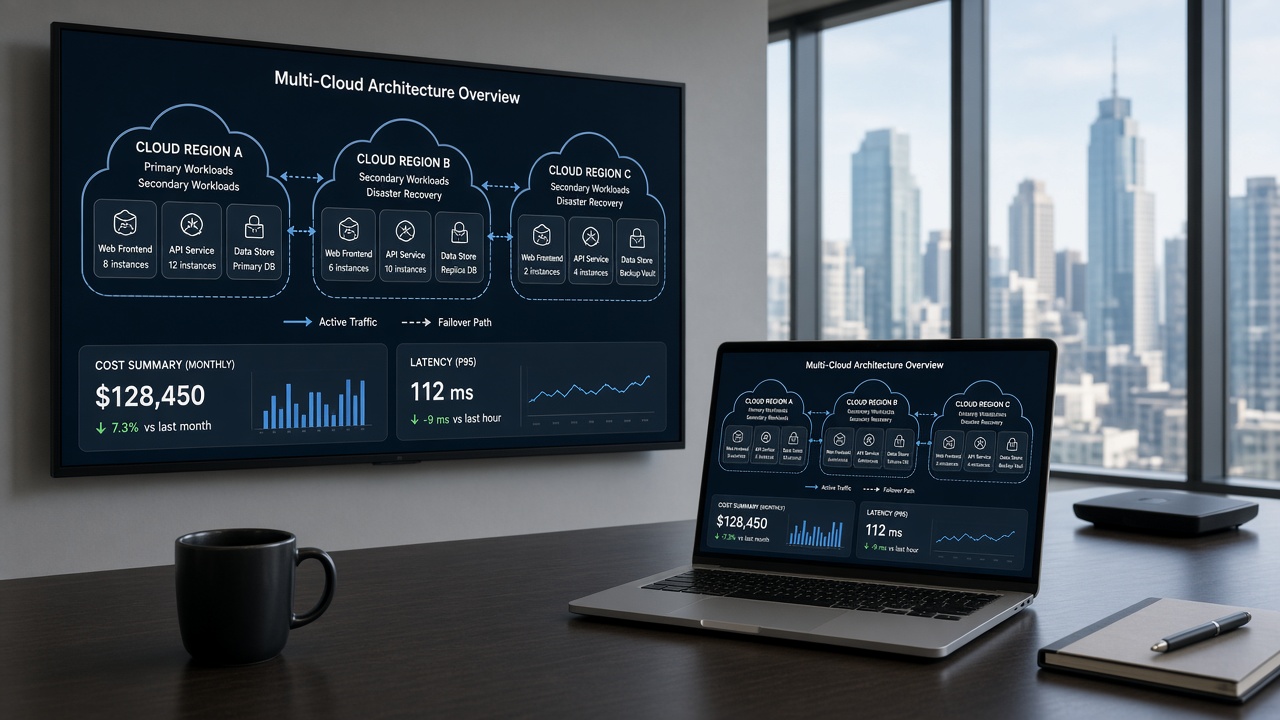
The mistake is treating multi-cloud as “use everything equally.” Successful mid-market adopters designate a primary platform for new builds and a secondary for specific workloads, with shared networking, logging, and cost visibility from the start.
Cost, compliance, and FinOps
Multi-cloud without FinOps discipline doubles the billing surprise risk. We recommend a single dashboard (native or third-party) tagging every resource by environment, product, and owner. UK businesses should factor in reserved instances and savings plans per provider rather than assuming one discount strategy transfers across clouds.
For regulated sectors, document which workloads hold personal data, which cross borders, and which provider certifications (ISO 27001, SOC 2, UK Cyber Essentials) cover each environment. Auditors care more about clear boundaries than about a single logo on your slide deck.
Migration without chaos
Start with connectivity: site-to-site VPN or dedicated interconnect, centralised DNS, and a shared secrets strategy. Migrate stateless services first; tackle data gravity second. Use infrastructure as code (Terraform, Pulumi) with modules per cloud so your team does not maintain three unrelated scripting styles.
Corrections: email hello@velosius.com with this URL. See our editorial policy.