Insights
Zero-trust security for UK and US regulated industries
14 May 2026 · 7 min read
 Kavindi JayasuriyaPrincipal, security & zero trust14 May 2026 · Updated 15 September 2026 · 7 min read
Reviewed by Priya Mendis, Healthcare systems lead.
Written from Velosius security reviews on regulated UK and US mid-market estates. Healthcare sections were reviewed by our healthcare lead. This is not legal or medical advice.
Not legal, medical, or certification advice. Healthcare notes were reviewed by our healthcare lead. Operators remain responsible for their own controls, BAAs, and filings.
Perimeter firewalls and “trusted internal network” assumptions fail the moment an employee laptop is compromised or a contractor VPN credential leaks. Zero-trust — verify every user, device, and request regardless of location — is now baseline guidance for UK financial services, US healthcare, and any firm handling sensitive customer data.
What zero-trust means in practice
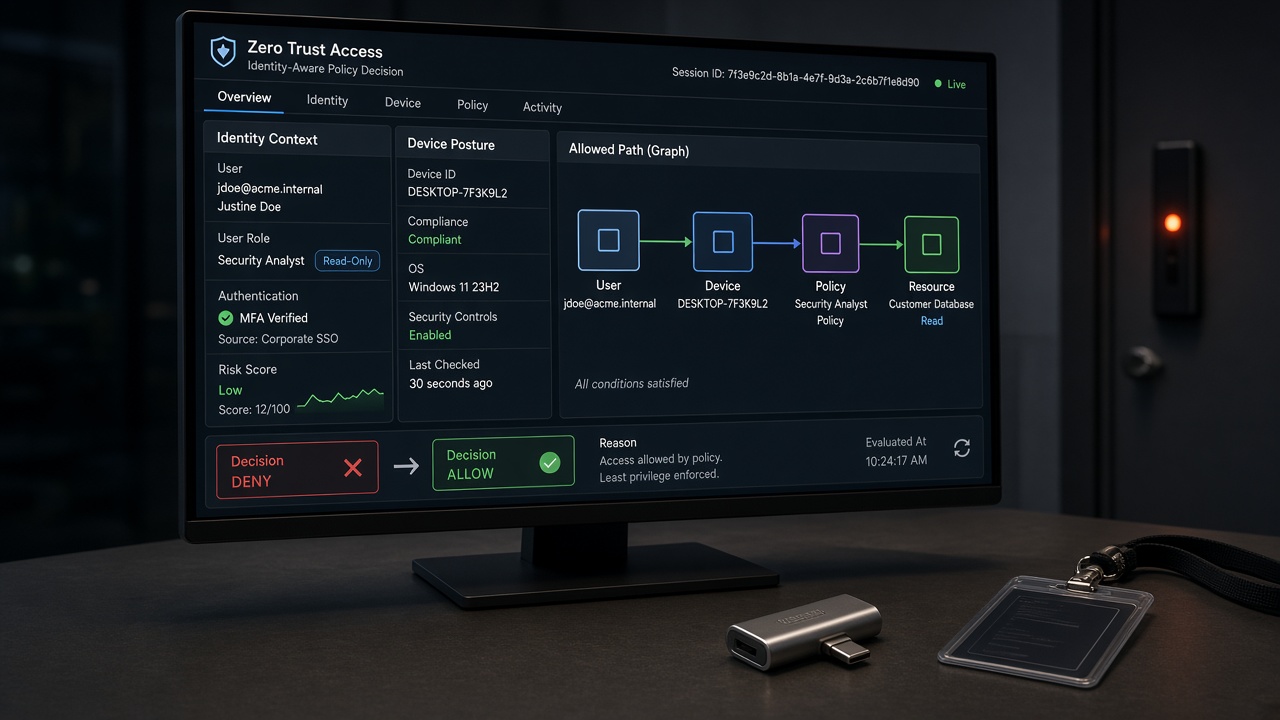
Zero-trust is not a single product. It is an architecture built on:
- Strong identity — MFA everywhere, conditional access, least-privilege roles.
- Micro-segmentation — services talk only to what they need; lateral movement is hard.
- Continuous verification — device health, location, and risk signals inform access decisions.
- Encrypted traffic — TLS in transit, encryption at rest, keys managed centrally.
- Observable systems — central logs, alerting, and incident playbooks tested quarterly.
For mid-market firms, the goal is implementable controls — not a three-year transformation that never ships.
UK and US regulatory context
UK regulators (FCA, PRA) expect firms to demonstrate access control and operational resilience. US healthcare organisations face HIPAA security rule requirements around access and audit trails; financial services firms align with FFIEC and state-level rules. Zero-trust mappings help in audits because they produce evidence: who accessed what, when, and under which policy.
Document your controls in language auditors understand — link each zero-trust pillar to a policy, a tool, and a named owner.
A phased rollout that works
- Phase 1 — Identity foundation (weeks 1–4): MFA, SSO, privileged access management, offboarding automation.
- Phase 2 — Network segmentation (weeks 5–10): separate production from dev, restrict database access to application subnets only.
- Phase 3 — Application layer (weeks 11–16): service-to-service auth (mTLS or OAuth client credentials), API gateways with rate limits.
- Phase 4 — Continuous improvement: purple-team exercises, zero-trust maturity scoring, annual policy review.
Mid-market teams should not wait for Phase 4 perfection before improving. Each phase closes real attack paths attackers exploit today.
Common pitfalls
Buying a “zero-trust platform” without fixing identity hygiene wastes budget. Exempting legacy apps from every control creates a permanent weak link. And shadow IT — unsanctioned SaaS with corporate data — must be discovered and either blocked or brought under SSO and DLP.
Corrections: email hello@velosius.com with this URL. See our editorial policy.